

 русский
 Español
 Deutsch
 عربى
 Português
 Français


 Oct 29, 2026
Which Brushless Mini Electric Winch Is Right for Your Lifting Job
Content
- 1 How to Choose a Brushless Mini Electric Winch
- 2 Brushless vs Brushed Mini Electric Winch
- 3 BL170 vs BL260 vs BL340 vs BL490
- 4 Explore the Brushless Mini Electric Winch Range
- 5 Which Jobs Suit a Brushless Mini Electric Winch
- 6 Brushless Mini Electric Winch vs Mini Electric Hoist
- 7 Why OEM Support Matters for Brushless Winch Projects
- 8 Selection Roadmap
Choose a brushless mini electric winch when you lift or pull often, need smooth speed control, and want less maintenance than a brushed motor. Pick the model by dividing your heaviest load by 0.8, which gives a 25 percent reserve: a 130 kg load points to the 170 kg BL170, a 200 kg load to the BL260, a 260 kg load to the BL340, and a 380 kg load to the BL490. The sections below explain how to size, compare and apply these winches in real projects.
How to Choose a Brushless Mini Electric Winch
A brushless mini electric winch is a compact winch driven by a brushless motor. It is built for hanging structures, installing glass, raising signs and light pulling work where space is limited and power comes from a standard supply. A correct choice depends on three checks: load, speed and working pattern.
Check 1: Total load
Add the weight of the cargo, hooks, slings, pulleys and any fittings. A common mistake is to count only the cargo. A 120 kg glass panel with suction frame and rigging can reach 150 kg, and that changes the model you need. Divide the total by 0.8 to reserve 25 percent capacity. For 150 kg the result is 188 kg, so the 260 kg class is a safer match than the 170 kg class.
Check 2: Lifting speed
Speed controls how long the job takes. A 10 m lift at 6 m per minute takes about 100 seconds. At 3 m per minute it takes more than 3 minutes. For repeated lifts, such as 30 board hangings in a day, that gap adds up to nearly an hour. If the load is fragile, choose a winch with fine speed control so the last few centimeters can be done slowly.
Check 3: Working pattern
If the winch runs a few short lifts per hour, almost any model works. If it runs many cycles per shift, a brushless drive gives better heat control and a longer service interval. Always read the duty rating and allow rest time between long runs.
Brushless vs Brushed Mini Electric Winch
Direct answer: a brushless winch is the better choice for daily or frequent work. A brushed winch is acceptable only for rare, light tasks where simple operation matters more than service life.
| Feature | Brushless Winch | Brushed Winch |
| Motor wear parts | No carbon brushes to replace | Carbon brushes wear and need checks |
| Heat during long use | Lower, thanks to higher efficiency | Higher, more friction losses |
| Speed control | Smooth, easy to fine tune | Less precise at low speed |
| Noise and dust | Quieter, cleaner inside the housing | Louder, brush dust builds up |
| Best fit | Frequent, repeated, precision lifting | Occasional, light tasks |
Why the difference matters on site
Imagine a crew that hangs 25 advertising boards a day. A brushed winch may need brush inspection and replacement after a heavy season, which means a day without the tool. A brushless winch removes that task. Efficiency also helps on battery-limited or generator-fed sites, because the same lift draws less power and produces less heat in the housing.
Brushless does not mean maintenance free. Inspect the rope, hook, latch, housing and control cable before each shift, and stop work if you see damage.
BL170 vs BL260 vs BL340 vs BL490
Direct answer: pick the smallest model that still leaves a 25 percent reserve above your heaviest load. Going larger than needed adds weight to carry, while going smaller risks overload.
| Model | Rated Capacity | Suggested Max Working Load | Typical Use |
| BL170 | 170 kg | About 136 kg | Light signs, small lighting, glass strips |
| BL260 | 260 kg | About 208 kg | Medium glass panels, advertising boards |
| BL340 | 340 kg | About 272 kg | Large panels, light structures |
| BL490 | 490 kg | About 392 kg | Heavier structures, workshop parts |
Reading the capacity steps
The jump from BL170 to BL260 is 53 percent more capacity. From BL260 to BL340 it is 31 percent, and from BL340 to BL490 it is 44 percent. If your load sits close to a limit, move up one class. For example, a 270 kg load needs about 338 kg with reserve. That is right at the edge of the BL340, so the BL490 is the more comfortable choice when rigging weight may vary.
Do not forget the pulley effect
A pulley block can reduce the force on the winch rope, but it also slows the lift. Using a two-part line cuts line speed at the load to about half. If a winch pulls 6 m per minute on a single line, the load rises at about 3 m per minute. Plan both force and time before you rig.
Explore the Brushless Mini Electric Winch Range
Brushless Winch Models
Nantong Powerful Hoist Machinery Co., Ltd. offers brushless mini electric winches from 170 kg to 490 kg, with OEM service from design and 3D engineering to mold making and certification. Open a model to see details.
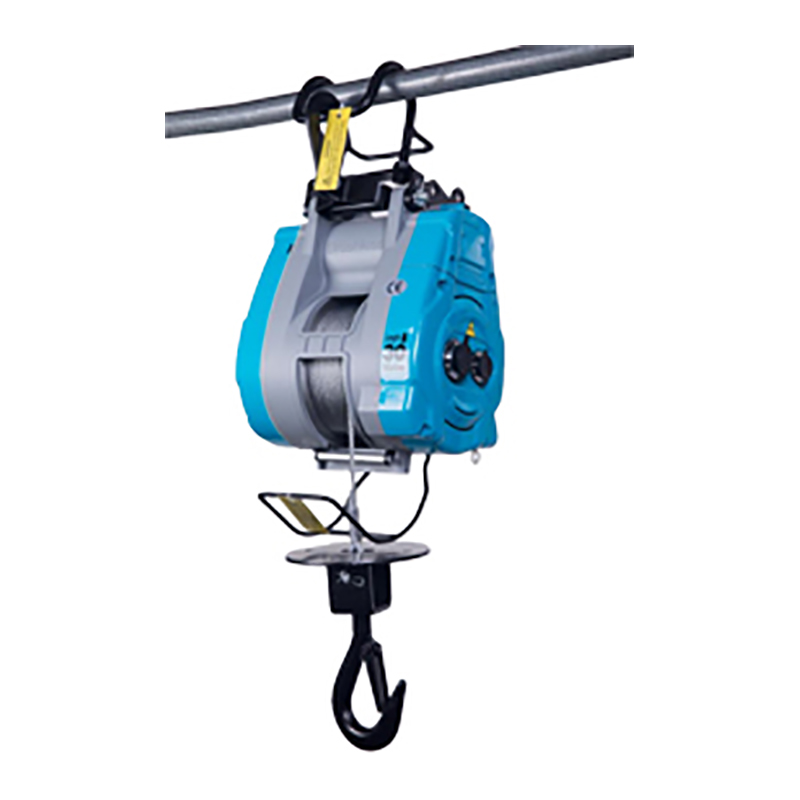 BL170 Mini Brushless Electric Winch Brushless Mini Electric Winch
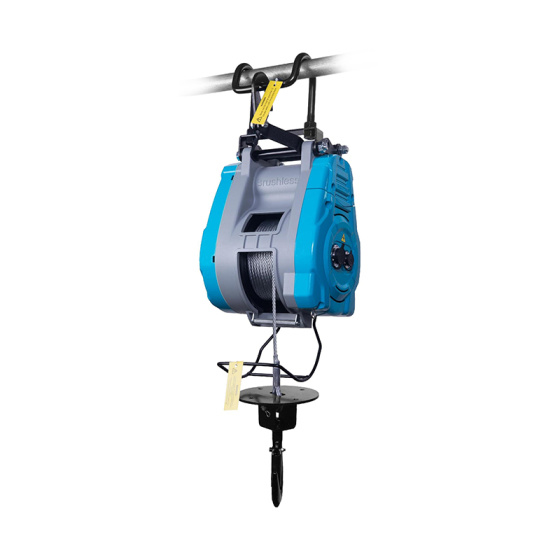 Model BL170 Mini Brushless Electric Winch Brushless Mini Electric Winch
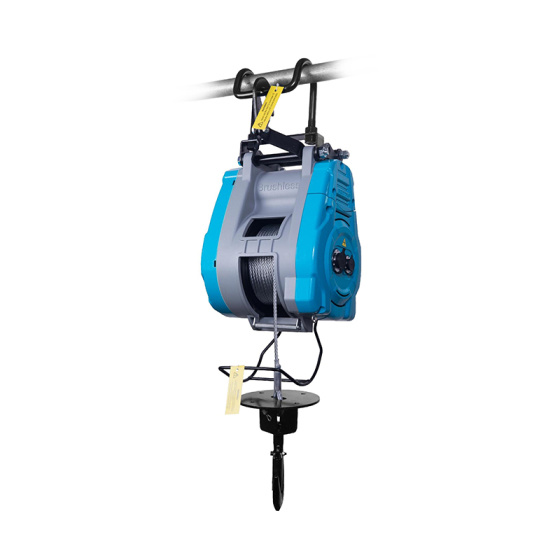 Model BL260 Mini Brushless Electric Winch Brushless Mini Electric Winch
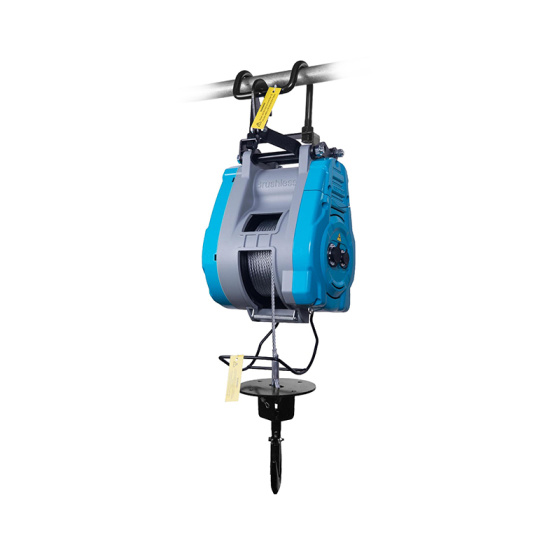 Model BL340 Mini Brushless Electric Winch Brushless Mini Electric Winch
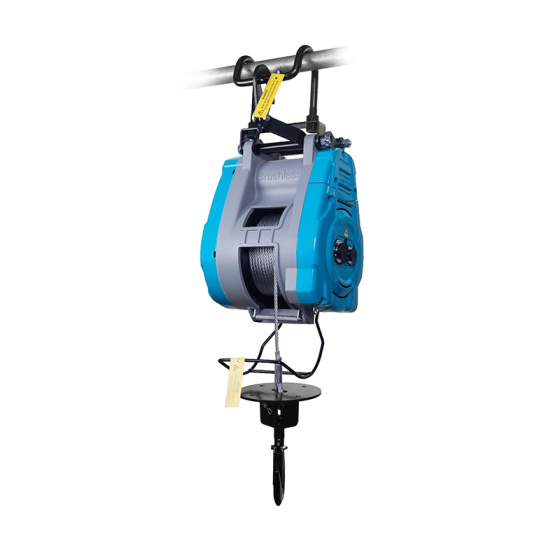 Model BL490 Mini Brushless Electric Winch Brushless Mini Electric Winch
Which Jobs Suit a Brushless Mini Electric Winch
Direct answer: these winches suit any job that needs compact, controlled lifting of structures, curtain-wall glass and advertising boards, especially where power is limited and the machine must be moved often.
Curtain-wall glass installation
Glass panels need slow, steady movement near the final position. A 1.8 m by 1.2 m panel of 12 mm glass weighs roughly 65 kg, and with suction lifters and rigging the load can reach 90 kg. A BL170 covers it with reserve, while larger panels move the choice to the BL260 or BL340. Smooth speed control lowers the risk of edge damage and rework.
Advertising boards and signs
Signs are hung high and often in tight spaces. A compact winch can be fixed to a beam, lifted by one person, and moved to the next position in minutes. For boards between 80 and 200 kg, the BL260 is a practical middle choice.
Structures and lighting rigs
Truss sections, speaker groups and light structures are raised, trimmed and lowered several times in a day. Brushless drive keeps temperature stable across these repeated cycles. For light structures near 300 kg, the BL340 or BL490 provides comfortable margin.
Do not lift people with a standard mini winch unless the product is specifically rated and certified for that purpose. Never stand under a suspended load, and always use rated slings, hooks and anchor points.
Brushless Mini Electric Winch vs Mini Electric Hoist
Direct answer: choose a winch for flexible rope work, angled pulling and varied rigging. Choose a mini electric hoist for straight, repeated vertical lifts with a chain.
Brushless Mini Winch
Rope drum, flexible routing through pulleys, suited to pulling and lifting, smooth speed control, and strong for glass, boards and varied rigging layouts.
Mini Electric Hoist
Chain lifting, direct vertical movement, simple hook position control, and well suited to repeated lifts at a fixed point.
If the lifting point is directly above the load and never changes, a hoist is simple and effective. If you need to redirect the line, lift at an angle or pull across a surface, the winch is more adaptable. Many crews keep both, using the winch for varied jobs and the hoist for fixed lifting points.
Why OEM Support Matters for Brushless Winch Projects
Direct answer: OEM support matters because a winch is more than a motor. Housing, gearbox, controls, labeling and certification all affect how it performs in your market. Nantong Powerful Hoist Machinery Co., Ltd. develops hoists and winches from sketch design to mass production, including 3D engineering, mold making and certification, and counts one of the largest power tool brands in the world among its customers.
What to prepare before an OEM inquiry
Share the target capacity range, lifting speed, power supply, duty cycle and destination markets. With these four points, engineers can confirm certification needs and tooling plans early, which avoids costly redesign later.
Selection Roadmap
Step 1. Add up the full load including rigging, then divide by 0.8.
Step 2. Match the result to BL170, BL260, BL340 or BL490.
Step 3. Confirm lifting speed, especially if you use a pulley block.
Step 4. Check the duty rating against your number of cycles per hour.
Step 5. Inspect rope, hook and anchor points before every shift.
Brushless mini electric winches give installers, event crews and workshops a compact, efficient and controllable way to lift. For model details, visit the brushless winch category, or request the catalogue through the contact page.
 CategoryRecent Post

- +86-13606283881 +86-0513-83278989
- [email protected]
- 19 Group, Xining Village, Tianfen Towen, Qidong City, Jiangsu, China
Copyright © Nantong Powerful Hoist Machinery Co., Ltd. All Rights Reserved.
OEM AC Electric Winch Manufacturer
Portable Electric Hoist Factory
